Model-based efficacy-estimand endpoint from slide 9; not the observed means in the connecting line plot and not the publication’s primary treatment-regimen weight estimate. Investigational; not FDA-approved.
Safety context
TRIUMPH-2 12 mg: diarrhea 34%, nausea 28%, hypotension 6%, dysesthesia 7%; permanent discontinuation due to adverse events or death 8%, versus 5% with placebo. Corresponding placebo event rates were 13%, 8%, <1% and 1%. Deaths occurred in all groups and investigators considered them unrelated to treatment.
Limitations: Highest planned dose, not largest HbA1c response: 9 mg decreased HbA1c 1.63 pp and 4 mg 1.41 pp in the same efficacy analysis. The trial primary endpoint was weight change. This longer diabetes/obesity cohort is separate from TRANSCEND-T2D-1; no head-to-head ranking across studies is justified.
Adults with type 2 diabetes inadequately controlled on metformin, with or without an SGLT2 inhibitor; BMI ≥25; trial-wide mean BMI 36.8
Sponsor efficacy estimand: assumes all randomized participants continued assigned intervention for 80 weeks, allowing dose interruptions/modifications, without adding antihyperglycemic medication for more than 14 days. Treatment-regimen estimates were not supplied. A1c noninferiority at 9 mg was multiplicity-controlled; superiority was a prespecified secondary nominal p<0.001, not family-wise error-controlled. Investigational; no U.S. approval.
Safety context
Retatrutide 9 mg versus semaglutide 2 mg: AE discontinuation 4.8%/2.7%, diarrhea 28.3%/26.4%, nausea 21.2%/21.3%, vomiting 10.2%/13.2%, dysesthesia 4.8%/2.7%. Exact arm denominators, confidence intervals and complete serious-harm tables were not supplied.
Limitations: Sponsor topline, open-label; modeled continued-treatment estimand. Confidence intervals, actual arm denominators, complete treatment-regimen analysis and full serious-harm tables are not supplied. Ozempic 2 mg was tested, not Wegovy 2.4 or 7.2 mg, and no tirzepatide comparison is established by this study. A1c noninferiority at 9 mg was multiplicity-controlled; superiority was a prespecified secondary nominal p<0.001, not family-wise error-controlled.
Adults with type 2 diabetes inadequately controlled on metformin, with or without an SGLT2 inhibitor; BMI ≥25; trial-wide mean BMI 36.8
Sponsor efficacy estimand: assumes all randomized participants continued assigned intervention for 80 weeks, allowing dose interruptions/modifications, without adding antihyperglycemic medication for more than 14 days. Treatment-regimen estimates were not supplied. A1c superiority at 12 mg was controlled for family-wise type I error (p<0.001). The primary objective was 12 mg noninferiority. Investigational; no U.S. approval.
Safety context
Retatrutide 12 mg versus semaglutide 2 mg: AE discontinuation 7.9%/2.7%, diarrhea 32.7%/26.4%, nausea 23.8%/21.3%, vomiting 15.0%/13.2%, dysesthesia 6.5%/2.7%. Exact arm denominators, confidence intervals and complete serious-harm tables were not supplied.
Limitations: Sponsor topline, open-label; modeled continued-treatment estimand. Confidence intervals, actual arm denominators, complete treatment-regimen analysis and full serious-harm tables are not supplied. Ozempic 2 mg was tested, not Wegovy 2.4 or 7.2 mg, and no tirzepatide comparison is established by this study. A1c superiority at 12 mg was controlled for family-wise type I error (p<0.001). The primary objective was 12 mg noninferiority.
Uses, doses and availability depend on the formulation, indication and country. Study doses below describe research; they are not prescribing instructions.
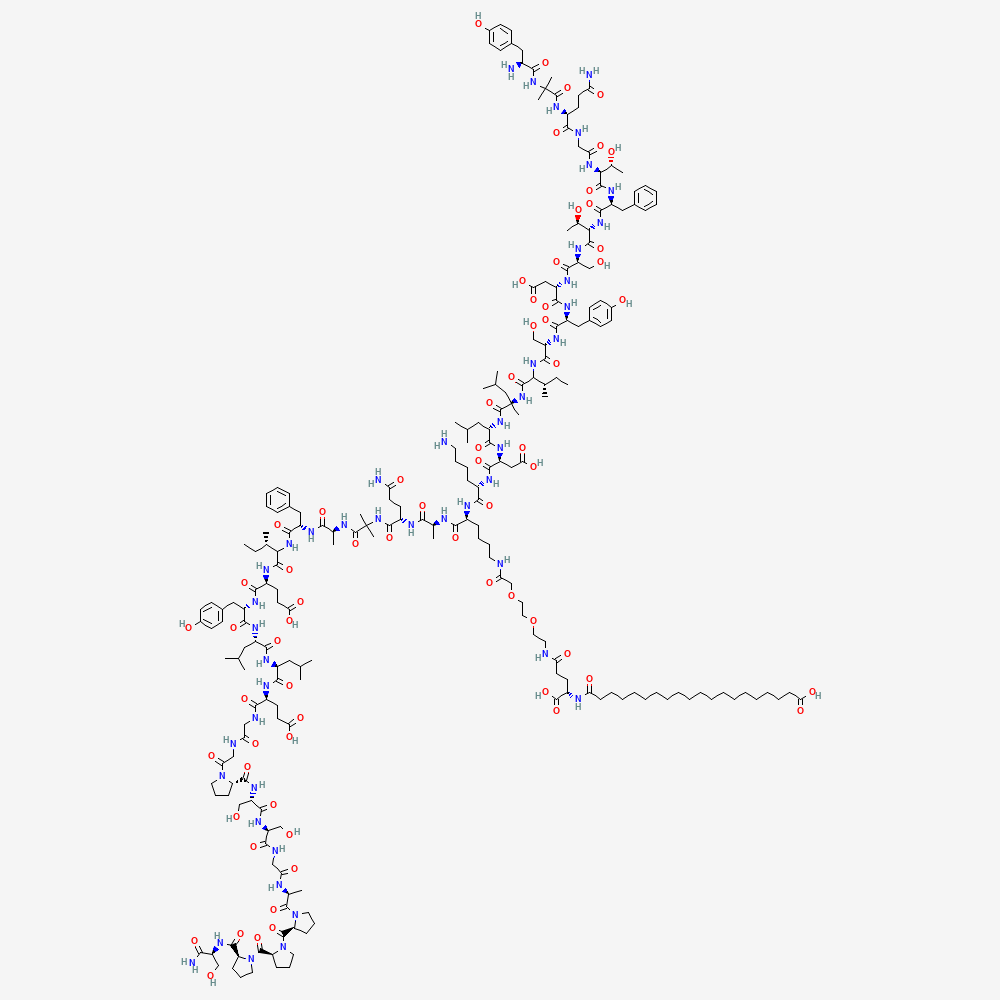
The lipidated 39-residue retatrutide molecule, including nonstandard residues and its linker/lipid branch.
Shown: Retatrutide molecule; not a sodium-salt substitute.
This full atom-and-bond diagram is dense; use a compact preview with an enlarge option. It is a two-dimensional connectivity diagram, not a 3D conformation. Identity is established by the IUPHAR-deposited retatrutide substance and its standardized compound mapping.
July 23 target reiterated August 5, 2026; not an FDA decision deadline.
Lilly targets a retatrutide Biologics License Application in Q1 2027. Its August update reiterates the target after completion of the clinical package for obesity, obstructive sleep apnea and knee osteoarthritis pain.
The sponsor says chemistry, manufacturing and controls work is part of the remaining package. Filing, FDA acceptance, benefit-risk review and approval are separate milestones.
Selected existing development milestones plus a focused November 11 appraisal of the November 9 CKD registry-result publication. This is not an exhaustive history; other programs retain their own review dates.
Phase 1b diabetes study published
Early multiple-dose safety, pharmacokinetic and pharmacodynamic findings for LY3437943 were published in adults with type 2 diabetes.
Lilly reported TRIUMPH-4 toplines in people with obesity and knee osteoarthritis. These are sponsor disclosures from a selected population, not the general-obesity chart trial.
Lilly disclosed phase 3 findings at 80 weeks in adults with obesity or overweight without diabetes; the disclosure date is not the study-completion date.
In 1,152 adults, 12 mg weekly reduced weight 18.8% versus 5.1% with placebo at 80 weeks using the primary treatment-regimen estimand. Each reported 0.7 uncertainty value is a standard error. The diabetes-selected cohort is kept separate from the TRIUMPH-1 non-diabetic weight map; GI events, hypotension, dysesthesia and treatment discontinuation remain important.
The 2,339-person non-diabetic trial publication adds diagnosis-specific OSA and knee-pain substudies. AHI and pain are separate from cardiovascular benefit and cartilage repair. The indexed abstract was appraised; full safety/supplements remain an access gap. Existing weight estimates and historical curves are preserved.
Two OSA subtrials included 243 people without T2D and 448 with T2D. At 80 weeks, 9/12 mg hybrid-estimand placebo-adjusted AHI differences were −24.4/−21.9 events/hour without T2D and −14.4/−15.1 with T2D; detailed uncertainty and estimand distinctions are in the linked primary abstract. AHI benefit does not establish fewer cardiovascular events or safe PAP withdrawal; full harms tables remain inaccessible. Existing weight/A1c data and curves are unchanged.
TRANSCEND-T2D-2 sponsor topline reports 80-week A1c and weight superiority at 12 mg versus semaglutide 2 mg in T2D, with more AE discontinuations. Efficacy estimand, open-label; full treatment-regimen estimates and confidence intervals remain unpublished. The 9 mg A1c superiority result is nominal; no retatrutide-versus-tirzepatide result is established.
NCT05936151 Phase 2b randomized 146 people with overweight/obesity and CKD, with or without diabetes. At 24 weeks the measured-GFR primary contrast was −1.44 mL/min/1.73 m² (95% CI −9.17 to 6.30); a smaller secondary albuminuria analysis favored treatment. Short-term biomarkers do not establish fewer kidney failures; endpoint and safety denominators differ.